

Maintenance, inspection, and painting at height are among the most critical activities in any offshore, naval, or port operation. Hulls, stacks, towers, pier structures, and platform sides rarely offer easy access - and the method chosen to reach them determines schedule, cost, and risk level all at once.
After more than a decade delivering work-at-height services with IRATA-certified teams, we put together this guide with the practical differences between rope access and traditional scaffolding - and how to decide which method makes more sense for each type of structure.
WHAT IS ROPE ACCESS (IRATA) AND HOW IT WORKS
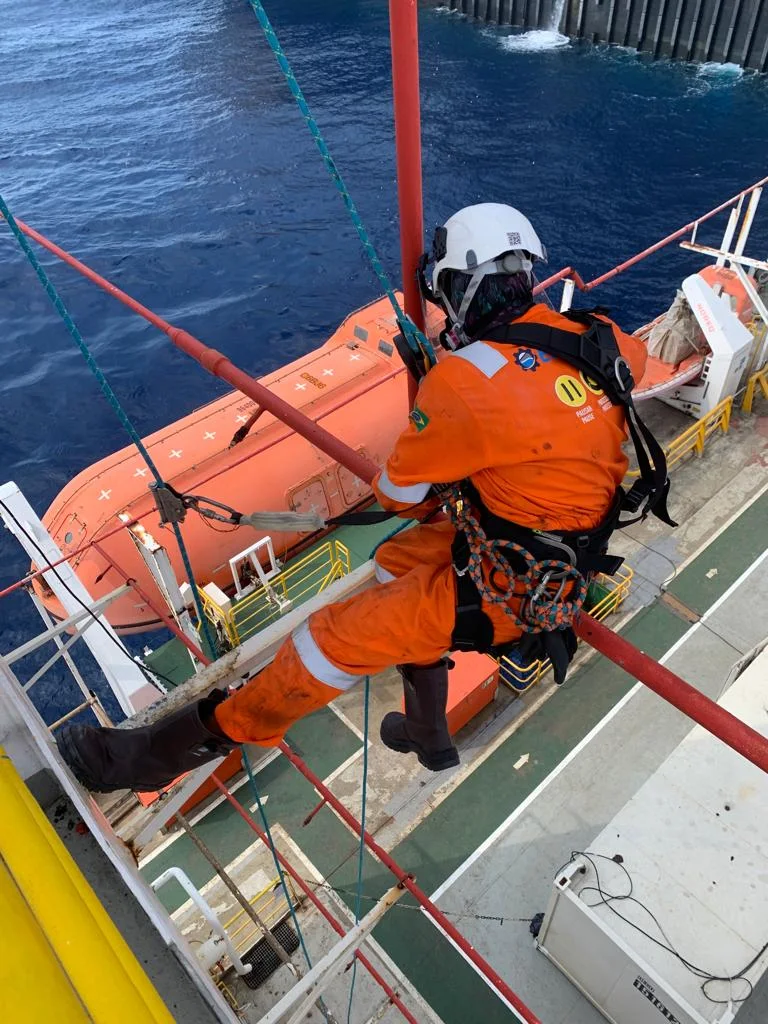
Rope access is a work-at-height technique in which the professional moves and works suspended from a rope system anchored to the structure itself, with no need to build platforms around it. The most widely recognized international standard is IRATA (Industrial Rope Access Trade Association), which defines training levels (Level 1, 2, and 3) and strict operating rules.
The foundation of the method\'s safety is the two-independent-rope system: a working rope, used to ascend, descend, and position, and a safety rope, which only comes into play if the first fails. Each rope has its own anchorage and equipment - no single point of failure.
ROPE ACCESS VS. TRADITIONAL SCAFFOLDING: WHEN TO USE EACH
There is no "best" method in every situation - there is the method suited to the structure, the scope, and the schedule. In general terms:
- Rope access is advantageous on hard-to-reach structures, spot or spread-out scopes (inspections, localized repairs, touch-up painting), when the schedule is tight, and when there is no room or structural capacity to build scaffolding.
- Traditional scaffolding is advantageous for long jobs concentrated in one area, that require a lot of material or heavy tools at the work point, or large crews working simultaneously in the same spot.
- Mobilization - rope access requires light equipment and quick mobilization; scaffolding requires assembly, inspection, and dismantling, steps that consume time (and hours of exposure to risk) before and after the job itself.
In practice, many projects combine both: scaffolding where the scope is dense and concentrated, ropes for isolated, hard-to-reach points.
6 PILLARS OF A SAFE ROPE ACCESS OPERATION
Regardless of the structure, operations that run well and without incidents share the same fundamentals:
Two-Rope System
Independent working and safety ropes, each with its own anchorage - no single point of failure.
IRATA-Certified Team
Technicians with up-to-date training and certification, supervised by a higher-level professional on every operation.
Rescue Plan
A defined rescue procedure and a trained team before the first access - never improvised after something goes wrong.
Equipment Inspection
Ropes, carabiners, descenders, and harnesses inspected and logged before every use, with immediate retirement of anything out of standard.
Risk Analysis and Work Permit
Every access is preceded by a risk analysis and formal release - weather, dropped objects, adjacent areas, and simultaneous tasks.
Communication and Supervision
Constant communication between the person suspended and the person on the ground, with a supervisor following the operation from start to finish.
COMMON MISTAKES THAT PUT THE OPERATION AT RISK
- Hiring on price without verifying certification - a team without IRATA (or equivalent) training and a verifiable track record puts people and structure at risk
- Poorly assessed anchorage - using a structure nobody verified can bear the load as an anchor point
- Ignoring dropped objects - a tool or material falling from height is a risk to anyone below, even with an isolated area
- No rescue plan - discovering at the moment of an incident that nobody knows how to perform the rescue
- Not accounting for weather - strong wind, rain, or lightning require immediate suspension of access
WHERE ROPE ACCESS FITS IN PRACTICE
In blasting and painting services on hard-to-reach structures, for example, rope access is often what makes it possible to deliver on schedule without building scaffolding along the entire length of the structure. We detail the technical fundamentals of that type of service in the guide below.
CONCLUSION
The choice between rope access and traditional scaffolding should start from the structure, the scope, and the schedule - not from habit. In either case, what separates a safe operation from an avoidable accident is the same: a certified team, inspected equipment, a risk analysis done beforehand, and a defined rescue plan. If your operation requires work at height, the earlier the method is evaluated, the more efficient and safe the result.
Frequently Asked Questions
IRATA (Industrial Rope Access Trade Association) is the international association that defines training, certification, and operating standards for industrial rope access. Certification has three levels: Level 1 technician, Level 2 (responsible for rigging systems and rescue), and Level 3 (operation supervisor).
When performed by a certified team, with the two-independent-rope system, inspected equipment, prior risk analysis, and a rescue plan, yes - it is a method with strict operating rules. Risks rise precisely when those steps are skipped or the team has no verified training.
For long jobs concentrated in one area, that require a large amount of material or heavy tools at the work point, or many professionals working simultaneously in the same spot, scaffolding is usually more suitable. In many projects, both methods are combined.
Yes. NR-35 is the Brazilian regulatory standard for work at height and applies to activities performed more than 2 meters above the lower level with fall risk, including rope access. The company must ensure training, risk analysis, work permits, and rescue procedures.
Yes. It is widely used for visual and non-destructive testing inspections, localized repairs, blasting and touch-up painting, and maintenance of hard-to-reach structures - especially where building scaffolding would be unfeasible or slow.